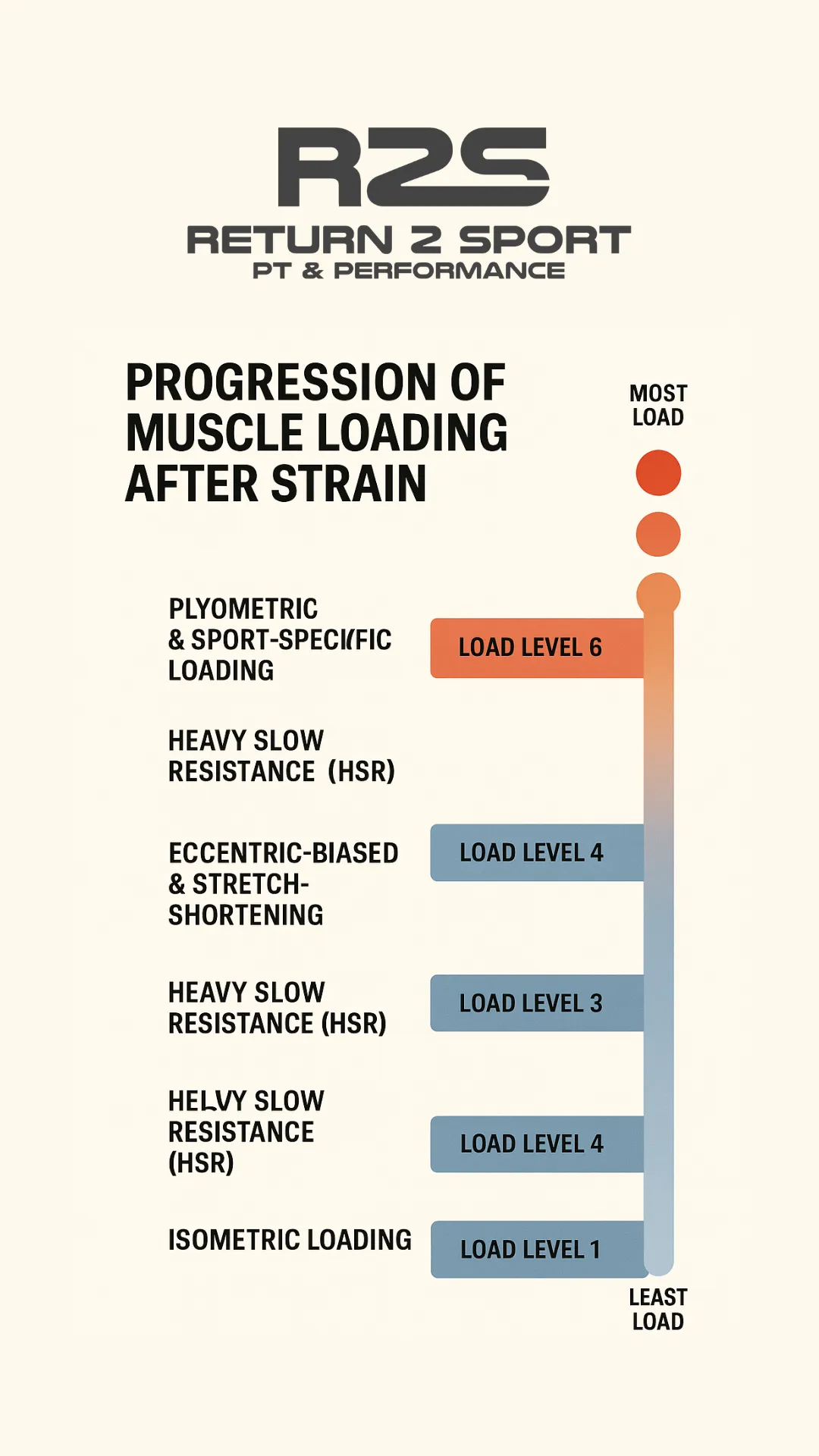
Progression of Muscle Loading After Strain

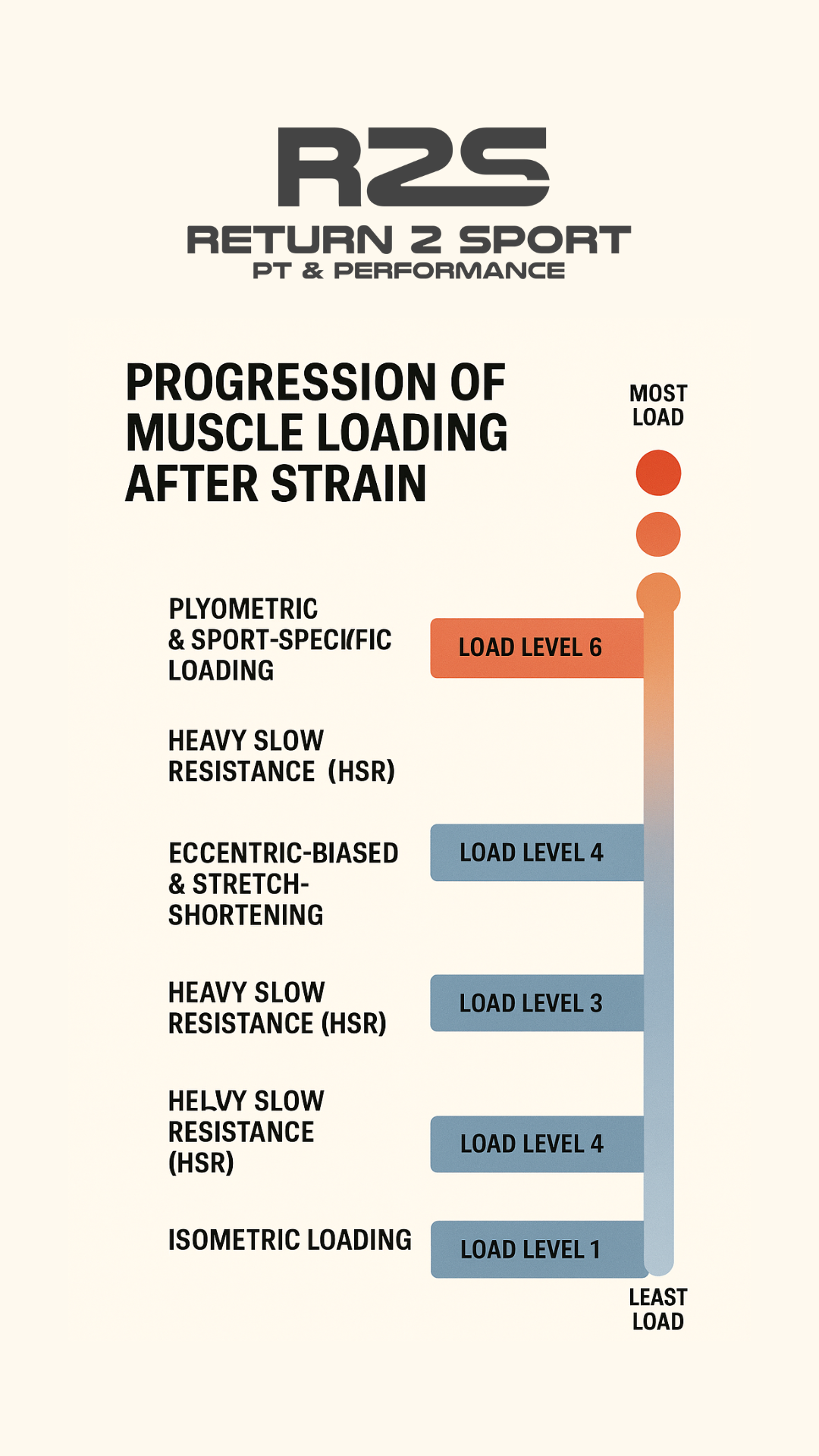
Muscle injuries require some reduction in load so that the body can work on the healing process without becoming further damaged.
We don't want isolated rest without progression of loading because it increases re-injury risk.
1. Isometric Loading (Least Load)
Goal:Reduce pain, reintroduce tension without length change.
Examples:
Static holds (e.g., wall sit, mid-range hamstring bridge hold, quad set)
Typically 5 x 45-second holds at ~40–60% maximal effort
Load Level:Minimal — muscle tension without joint movement.
When:Early rehab (pain > 3/10 at rest).
2. Short-Range Concentric Loading
Goal:Reintroduce movement and controlled muscle shortening.
Examples:
Heel slides, mini squats, short-arc knee extensions
Light band or bodyweight resistance only
Load Level:Low to moderate — some mechanical work, limited stretch.
When:Once isometrics are pain-free.
3. Full-Range Concentric + Controlled Eccentric
Goal:Restore range, control, and light stretch under tension.
Examples:
Slow squats, step-ups, banded hamstring curls, bridge curls
Controlled tempo (3–4s eccentric)
Load Level:Moderate — full joint range but still submaximal force.
When:Mid-rehab; pain-free through range.
4. Heavy Slow Resistance (HSR)
Goal:Build tissue capacity and strength under load.
Examples:
Romanian deadlifts, squats, lunges, Nordic lowers
3–4 sets of 6–8 reps, 3s eccentric / 3s concentric
Load Level:High — heavy tension, slower movement, still controlled.
When:After full range, near-normal strength, minimal pain.
5. Eccentric-Biased & Stretch-Shortening
Goal:Prepare muscle for deceleration and dynamic forces.
Examples:
Drop squats, eccentric calf lowers, eccentric-only RDLs
Focus on control and rate of tension development
Load Level:High mechanical load, higher stress tolerance.
When:Late rehab; tolerated HSR and no pain during elongation.
6. Plyometric & Sport-Specific Loading (Most Load)
Goal:Rebuild power, elasticity, and sport readiness.
Examples:
Skips, bounds, hops, sprint drills, cutting, acceleration work
Gradual increase in intensity, volume, and velocity
Load Level:Maximal — high force and fast stretch-shortening cycle.
When:Final phase before return to play.
If you need help and want to have professional PT's make sure your rehab is excellent give us a call.
Ready to book an evaluation? Click the link below to book a call with one of our PT's today ⬇️
Book FREE 15- Minute Phone Consultation
Also, If you are dealing with an injury and need help or would like to optimize your performance and recovery with some professional help, book a phone consultation below!
We also provide:
Click the button below to sign up for the newsletter to learn more! Members will get exclusive running content, special sales, and most importantly super helpful information for anyone who wants to better themselves!
Dr. Dylan Glass, PT, DPT, SMTC
Dr. Josh Cornett PT, DPT, COMT, CDNT
Return 2 Sport PT
256-513-9525



Copyright (C) 2025 Return 2 Sport PT & Performance. All
rights reserved.